A curriculum that felt right from the start
Before Cornerstones arrived at ALP Leicester, history and geography simply were not happening in any structured way. When the curriculum lead, Charlie Baughan, was first shown the platform, the decision came quickly, not because it promised a transformation, but because it felt manageable and immediately usable.
We spoke to Tracy Tew and Jack Cooper, both base teachers from ALP Leicester, about their experience implementing Cornerstones, the effect it’s had on inclusivity for their learners, and the impact on teaching and learning.
'We weren't actually doing any focused history or geography before implementing Cornerstones. But when I was introduced to Cornerstones, I liked it straight away. It was so easy to navigate the platform. The lesson plans and resources were amazing, and I could adjust them to my learners' needs at the time.'
Content that does not talk down
One of the real worries for any SEND setting adopting a mainstream curriculum is whether the material will feel patronising to older learners working at an earlier stage. At ALP Leicester, learners aged 11 to 14 access content broadly equivalent to Year 3. The concern about tone and dignity proved, in practice, to be unfounded.
'Our learners aged between 11 and 14 are accessing the National Curriculum at a Year 3 level. But as for the curriculum content? I have never felt like I have had to switch it up, as the lessons and resources are not condescending. It's accessible to all our learners, regardless of age or ability, and engaging for everyone.'
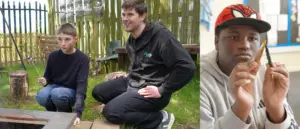
'One thing I love to combine that links really well with the curriculum is gamifying our lessons. For example, in today's lesson, our learners have been getting hands-on as they created artwork on arrowheads from three different periods. They were asked to name and date each one. We then built a fire in our forest camp to replicate what it might have felt like to live in the Stone Age, and we asked questions about what it felt like. Granted, the marshmallows were an additional treat. But this all relates back to our first lesson, where we were learning about chronology. Our first lesson was all about timelines with a special focus on the Stone Age. Then we looked at everyday life with them, and then in our third lesson, today's lesson, they got to experience it for themselves.' 'As for the geography lessons, we are currently working on hemispheres. So, the approach I have taken with that is to ask my learners, 'Why is it nighttime in Australia when it's daytime for us?' And that's the sort of hook that they like. I then followed it with a game of Simon Says, asking them to point out north, east, south and west. But the only reason I have the time actually to do any of this in my lessons is that I've got actual resources on hand as a baseline, which gives me far more freedom to really specify what my learning goals are and where my learners are at. There's so much more capacity to do that when you're not spending your time looking for resources or information which actually relates to your lesson.' 'The Cornerstones platform also allows me to bridge any gaps, so I'm not just teaching from a script that meets the national curriculum requirements.' 'It's really refreshing because I'm then able to focus on the engaging side of learning rather than just telling my learners what they need to know and presenting it through a dull presentation. My goal is to figure out how to make a lesson's knowledge stick, and that's the really enjoyable part of my job.'
Adapting the pedagogy for hands-on learners
The school has not followed the Cornerstones four-stage model in its original sequence. Instead, teachers have shaped it around how their learners respond best, keeping the structure purposeful while making it genuinely their own.
'Don't be afraid to adapt. I know the Cornerstones pedagogy has four stages, but we combined them for our learners. We use Engage for its hook, then dive straight into a merged Develop and Innovate, as our learners prefer a hands-on approach. And finally, we gamify Express to end the topic on a high note.'
'For my learners, my main aim is to give them independence, and the Cornerstones curriculum supports this. Your memorable experiences get our learners into the real world, they give them a better life experience, and a better chance because they have experienced culture.'
The impact on learners
After three years with the curriculum, the evidence of impact is showing up in the way learners hold on to and connect their knowledge over time. When the school moved from a unit on the Romans to one on the Egyptians, learners were drawing on what they already knew, making chronological links without being prompted.
'Recall. Their recall is very good. That's one of the things that Ofsted was so impressed with, because when we moved onto Egyptians when they were in, our learners were able to demonstrate the links in dates and other knowledge from their previous term when learning about the Romans.'
Summary
For any SEND school wondering whether a curriculum built for mainstream settings can genuinely stretch to meet their learners, ALP Leicester’s experience over three years offers a straightforward and honest answer. The content holds up, the dignity of older learners is not compromised, and the workload for teachers comes down rather than goes up, because the hard work of resourcing is already done.
What makes it work is the willingness to treat the curriculum as a starting point rather than a fixed script. Adapting the pedagogy, building in real-world experiences, and focusing time on knowing individual learners rather than hunting for materials; all of that becomes possible when the foundations are in place. The question for SEND leaders is not whether a curriculum like this can be inclusive. It is whether there is time and space to make it their own, and the answer, at ALP Leicester, is yes.