

The first tranche of Ofsted reports always gives primary senior leaders something useful: a clearer view of what is being noticed, valued and tested in the current inspection landscape. Whether we welcome that or not, it matters.
Understanding inspection expectations is not about chasing language or performing for a framework. It is about knowing the standard schools are being held to, so leaders can respond intelligently, protect what matters most, and strengthen provision where it will make the greatest difference to children.
Accountability matters. We could debate for hours whether Ofsted, in its current form, improves education, distorts it, or places too much weight on certain aspects of school life. Some schools see inspection as a gathering storm; others as validation, or even as a useful external lens. Whatever your view, Ofsted remains a significant force in the system. Schools have to contend with it, while standing firm on what they know is right for their children, staff and communities.
So what are the reports telling us? What can primary leaders learn from them that will genuinely help improve pupils’ life chances, rather than simply increase compliance?
Having analysed more than 150 recent primary inspection reports, with a particular focus on achievement, early years, curriculum and teaching, some clear patterns are emerging.
What Ofsted appears to expect
Curriculum and teaching
Where curriculum and teaching are judged to be at the expected standard or above, the picture is remarkably consistent.
The curriculum is broad, coherent and ambitious. End points are clearly identified. Knowledge and skills are sequenced logically from the early years to Year 6 so that pupils build securely on what they already know. Communication, language and early reading, especially systematic phonics, sit at the heart of this work. Reading, writing and mathematics are given due priority, but not at the expense of breadth. Foundation subjects are taught with clarity and purpose, not treated as an afterthought.
Teaching is strongest where staff have secure subject knowledge and use it well. Explanations are clear. Modelling is precise. Checking for understanding happens routinely, not occasionally. Misconceptions are identified and addressed quickly. Pupils revisit important content, practise deliberately, and apply learning in a way that helps it stick.
There is also a high premium on consistency. Stronger reports describe implementation that is reliable across classes and year groups, not excellent in pockets. Leaders are expected to know whether the intended curriculum is actually being taught and learned over time.
A further theme is inclusion without dilution. Disadvantaged pupils and pupils with SEND are expected to access the same ambitious curriculum as their peers, with intelligent adaptation rather than reduced expectation. The strongest provision combines early identification, well-targeted support and sharp leadership oversight, so gaps are addressed quickly rather than explained away.
In simple terms, the message is this: a strong primary school offers a well-sequenced, ambitious curriculum, taught consistently well, with responsive teaching and high expectations for all.
What this looks like in practice
In the schools we work with most successfully, this usually means three things.
First, curriculum thinking is secure. Leaders have clarity about what pupils should know and be able to do, and that thinking is reflected in classroom practice rather than left in planning documents.
Second, teaching is responsive. Staff check understanding well, address errors quickly and use assessment as part of teaching, not as a separate event.
Third, adaptation is purposeful. Staff know pupils well, particularly those with SEND and those facing disadvantage, and make changes that support access to the full curriculum rather than narrowing it.
These schools tend to show the same core features in inspection evidence: logical curriculum sequencing, deliberate revisiting of prior learning, effective formative assessment, and staff who understand how to support pupils without lowering the bar.
Early years: the foundations matter more than ever
The same pattern is visible in early years.
Where provision is judged positively, children are safe, settled and known. Relationships are warm and consistent. Routines are clear. Children quickly develop a sense of belonging, alongside growing confidence, independence and self-regulation.
The strongest EYFS provision is ambitious and well organised from entry to the end of Reception, with a clear line of sight into Year 1. There is a particularly sharp focus on the prime areas, especially communication and language, alongside early reading, writing and number.
Adult interaction is a defining feature. In stronger settings, adults model language well, extend vocabulary, narrate play with purpose, and use assessment continuously to adapt provision and provide support. Where children need extra help, it is swift and precise. Where partnerships with parents are strong, staff build a more accurate picture of children’s starting points and needs from the outset.
This matters because it is in early years that many barriers first become visible, and where schools have the greatest chance of preventing those barriers from becoming entrenched.
Achievement: more than test outcomes
Inspection language around achievement still places significant emphasis on outcomes, particularly in reading, writing and mathematics, but reports also point to something broader.
Achievement is strongest where pupils make good progress from their starting points, attain in line with or above national benchmarks, and show secure learning over time. Their work demonstrates that they know more, remember more and can apply what they have learned accurately and fluently.
This applies across the wider curriculum too. High-quality work in foundation subjects, secure recall of key knowledge, and the ability to use learning independently all appear to matter.
Again, there is a strong emphasis on groups. Disadvantaged pupils, pupils with SEND, and those who join the school mid-phase are expected to achieve well. Effective schools do not simply track gaps; they act on them. They identify weaknesses in foundational learning early and address them before pupils drift further behind.
Achievement, then, is not just about published outcomes. It is about whether pupils are genuinely being prepared for what comes next.
The real challenge for schools
None of this is especially surprising. In many ways, it reinforces what effective school leaders already know.
Schools are being asked to secure an ambitious, coherent curriculum for all pupils; ensure that all subjects are taught well across the whole school; protect breadth while securing the basics; use assessment formatively; and adapt effectively for pupils with SEND and those facing disadvantage. It is an exacting standard.
The challenge is not understanding the expectation. The challenge is delivering it consistently in the real world of staffing pressures, stretched budgets, rising need and increasing complexity.
That is why the biggest issue facing primary schools is not whether standards are high. It is whether the current accountability model helps or hinders schools in meeting them.
The publication of Every Child Achieving and Thriving only sharpens that tension. Its ambitions are hard to argue with, but the operational reality is significant. In many schools, particularly for SENCOs and pastoral leaders, this means more responsibility layered onto already overloaded roles. The pressure to identify, support and close gaps for pupils with SEND and disadvantaged pupils is entirely right in principle, but extremely demanding in practice.
And this is where the key question sits.
Is the Ofsted report card a barrier to learning?
It can be.
Not because accountability itself is wrong, but because accountability can become distorting when schools feel compelled to organise around presentation rather than purpose, or when leaders are pulled away from deep school improvement into performative readiness.
A report card model may promise clarity. It may even improve transparency in some respects. But if it leads schools to fragment their improvement work into inspectable components, or to over-focus on label and judgement rather than substance, it risks becoming a barrier rather than a driver.
The danger is not high expectation. Schools need high expectation. The danger is when external accountability narrows leaders’ attention at precisely the moment they need to think most carefully about context, capacity and children’s lived realities.
Primary leaders know that no two schools are the same. No two cohorts are the same. On some days, no two classes are the same. Effective leadership is not about blindly reproducing a model. It is about understanding the pupils in front of you, knowing what they need, and building systems strong enough to help staff meet those needs consistently.
That is why the best school improvement work starts not with Ofsted language, but with deep knowledge of children.
What leaders should take from this
The most effective school leaders do three things well.
They understand the external standard.
They translate it intelligently into their own context.
And they keep the child, not the framework, at the centre of decision-making.
That means being clear about expectations in behaviour, curriculum and teaching. It means making sure staff understand those expectations and can implement them consistently. But it also means identifying the barriers that stand in the way for individual pupils, whether linked to SEND, disadvantage, attendance, speech and language, summer birth, behaviour, vulnerability, or wider contextual factors.
Great schools know their children in detail. They make that knowledge usable for teachers. They ensure that information leads to action, not just monitoring. Because when teachers know both the standard they are aiming for and the barriers a child is facing, they are far better placed to help that child succeed.
Knowing and monitoring are not ends in themselves. Used well, they are powerful tools for helping teachers remove obstacles, unlock pupils’ strengths and enable more children to thrive.
Final thought
Ofsted reports are useful, not because they tell school leaders everything, but because they reveal the current grammar of accountability. That grammar matters. Leaders need to understand it. But they must not become trapped by it.
The schools that do this best are not the ones that chase inspection. They are the ones that build strong foundations, know their pupils deeply, support staff well, and hold fast to a clear view of what excellent primary education should look like in their community.
If the report card supports that work, it has value.
If it distracts from that work, it becomes part of the problem.
And that is the line primary leaders will need to hold.
Help is available
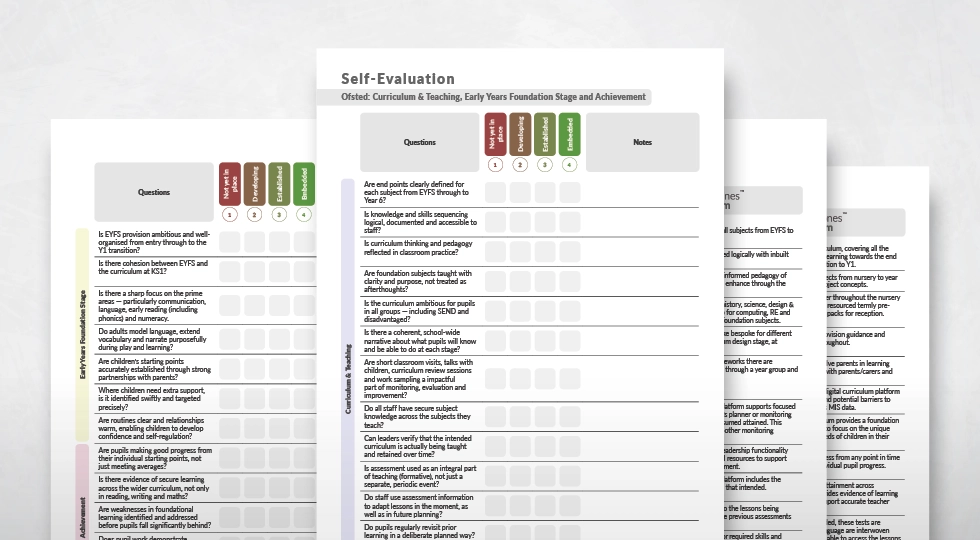
Check if your school meets the requirements of the new Ofsted framework with our free self-evaluation checklist.
Want to know how Cornerstones can help?
Our curriculum advisers offer a free personalised walkthrough of our curriculum and digital platform, so you can find out if Cornerstones is right for your school.